

Every December the property tax bill lands in Gulf Coast mailboxes, and plenty pay it without a second look. New buyers budget off the seller’s tax figure and assume it carries over, but Mississippi’s homestead exemption is not automatic. You file in person at your county tax assessor in a short window each spring, and late filings are not accepted.
In this article, I’ll show you who qualifies, what filing saves on a Gulf Coast tax bill, and when a new buyer can file. You’ll also learn how to file with the county tax assessor and when you have to file again. Miss the window, and you lose a full year of savings.
Filing for Mississippi’s homestead exemption by April 1 gets your primary home assessed at 10% instead of 15%, plus a tax credit. On a Biloxi home selling for $265,000, that saves about $1,196 a year under 65, and $1,734 at 65 or totally disabled.
Who Qualifies for the Mississippi Homestead Exemption
Mississippi created the exemption in the 1930s to encourage home building, ownership, and family security. That is why every test below ensures you own the home and live in it.
- You own the home and live in it as your main residence on January 1 of the year you file
- You comply with Mississippi income tax, and you have not claimed residency in another state for income tax
- All of your vehicles, including a company vehicle you drive, are registered in Mississippi. New residents have 30 days after moving (opens in a new tab) to register
- You are the head of a family, the one person who files for the household. It is a homestead-law term, not your income tax filing status. You claim only one homestead and use a street address, not a P.O. box
If you’re still unsure if you qualify, go through the questions below.
Four questions decide whether you can file, and for which tier

Show the questions
| Question | If yes | If no |
|---|---|---|
| Do you own the home and live in it as your main home on January 1? | Go to the next question | Bought after January 1? File next spring. Second homes and rentals never qualify. |
| Is the title in your own name, not a trust, an LLC, or heirs? | Go to the next question | Ask your county tax assessor |
| Are you a Mississippi resident for income tax with Mississippi car tags? | Go to the next question | Get Mississippi tags and residency first, then file |
| Are you 65 or older, or totally disabled, on January 1? | File for the 10% rate and the age and disability exemption | File for the 10% rate and the regular credit, up to $300 a year |
Trusts, LLCs and inherited homes: ask your county tax assessor before you count on it.
What the Exemption Saves on a Gulf Coast Tax Bill
Filing does two things for an owner under 65. Your home is assessed at 10%, and you get a tax credit of up to $300 a year. Owners 65 or older (or totally disabled) swap the $300 credit for something bigger: Mississippi stops taxing the first $7,500 of assessed value (opens in a new tab).
Assessed value is the part of a home’s value that gets taxed. A home you live in is assessed at 10% only once you file. Without filing, it is assessed at 15%, the same as a second home or rental.
A Worked Biloxi Example on a $265,000 Home
In Biloxi, the county values a typical home at about 60% of its sale price. That ratio comes from our research, which matched Gulf Coast sales to the county rolls.
Calculating your Biloxi tax bill and homestead savings
We use $265,000, the Gulf Coast’s median sale price from July through September 2026, as the example sale.

Assessment rate: 10% once you file, 15% if you don’t. The 5% is the difference.
Credit or exemption: up to $300 under 65. At 65 or older, or totally disabled, the tax on the first $7,500 of assessed value.
| Not filed | Under 65 | 65 or older | |
|---|---|---|---|
| County’s value | $160,325 | $160,325 | $160,325 |
| Assessment rate | 15% | 10% | 10% |
| Assessed value | $24,049 | $16,033 | $16,033 |
| Tax at 111.77 mills | $2,688 | $1,792 | $1,792 |
| Credit or exemption | none | minus $300 | minus $838 |
| Yearly tax | $2,688 | $1,492 | $954 |
| Filing saves | $0 | $1,196 | $1,734 |
Sources: Biloxi total millage, Harrison County 2025 tax levy, and our research matching Gulf Coast sales to the county rolls, October 2026.
Most of what filing saves comes from that lower assessment rate, not from the credit.
Where the $300 Credit Stops Growing
For an owner under 65, the $300 credit covers about 17% of the $1,792 bill before the credit. That is a real slice of what owning a home in Biloxi costs.
The credit reaches its full $300 once the assessed value hits $7,351. In Biloxi, that is a home selling for about $121,500.
Above a Biloxi sale of about $124,000, neither the credit nor the age and disability exemption grows any larger. But the gap between the 10% and 15% assessment rates keeps widening as the home’s price rises.
The bigger the home, the more filing saves
Yearly saving from filing in Biloxi, against the bill for a home not filed, by the home's sale price, 2025 tax rates

Show the numbers
| Sale price in Biloxi | Under 65 | 65 or older |
|---|---|---|
| $100,000 | $584 | $1,014 |
| $200,000 | $976 | $1,514 |
| $265,000 | $1,196 | $1,734 |
| $400,000 | $1,652 | $2,191 |
Biloxi millage 111.77. County value: 0.605 of sale price. The credit and the age and disability exemption stop growing near a $124,000 sale.
What Filing Saves in Four Gulf Coast Cities
The Department of Revenue treats the $7,500 as the first $75,000 of the county’s value. Add the lower 10% assessment rate, and filing saves the most where the tax rate and the county’s value are both high.
What filing saves a year on a $265,000 sale in four Gulf Coast cities
| City | County's value (share of sale price) | Tax rate (mills) | Saves, under 65 | Saves, 65 or older, or totally disabled |
|---|---|---|---|---|
| Biloxi | $160,325 (60.5%) | 111.77 | $1,196 | $1,734 |
| Gulfport | $149,990 (56.6%) | 131.96 | $1,290 | $1,979 |
| Ocean Springs | $126,670 (47.8%) | 145.01 | $1,218 | $2,006 |
| Bay St. Louis | $135,415 (51.1%) | 119.70 | $1,110 | $1,708 |
Saving against the same home not filed. County's value: sale price times the city's value-to-price ratio. Tax rates inside city limits, except Bay St. Louis.
A bigger figure circulates online, and it is wrong.
The $12,500 figure some online answers give does not match state law
What some online answers say, AI summaries included: the over-65 exemption covers the first $12,500 of assessed value.
What the Department of Revenue says: the first $7,500 of assessed value goes untaxed.
The bills that would have raised it: HB 1255 (2025) (opens in a new tab), HB 913 (2026), and HB 1868 (2026) (opens in a new tab). All three died in committee.
Source: Mississippi Legislature bill status, checked 2026-10-15.
What the County Rolls Show About Homestead Filing
On the 2023 county rolls, only about half of residential parcels in three Gulf Coast cities carry the exemption: 47% in Biloxi, 46% in Gulfport, and 47% in Bay St. Louis. The rest include rentals, second homes, recent purchases, vacant houses, and some owners who live there and never filed. The rolls cannot say how many of each.
If your own bill arrives at the house you live in with no homestead on it, call your county assessor. And if a neighbor, a parent, or a friend might be missing out, email them this guide.
When a New Buyer Can File for the Homestead Exemption
A seller’s homestead exemption does not pass to you when you buy the home. You file your own, and the year you close decides your filing window. The deed proving your ownership must be on file with the chancery clerk, the county office that records deeds, on or before January 7.
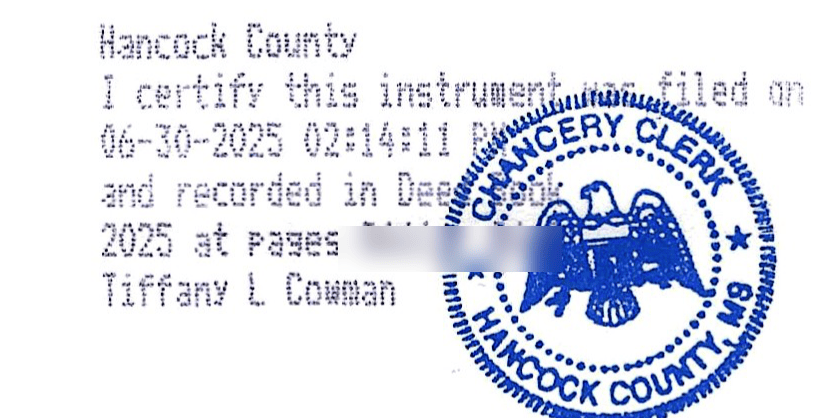
Close any day in 2026 after January 1, and you file between January 1 and April 1, 2027. Your first bill with the exemption arrives in December 2027 and is due by February 1, 2028. Mississippi bills property tax after the year it covers, so that December bill pays for all of 2027, not the year ahead.
A listing’s tax figure reflects the seller, and it may already include their exemption or their age and disability exemption. Your own bill can run higher, even after you file. Lacey has caught buyers assuming that number would be theirs.
I had a couple from Wisconsin buy a condo here for the winters, and they were doing their math off the tax number the seller had been paying. I reminded them that the seller’s tax bill will not be their tax bill.

How to File by April 1 at the County Assessor
You file in person at your county tax assessor’s office. The filing window runs January 1 to April 1 of the year you want the exemption.
- Your deed must be recorded with the chancery clerk on or before January 7. Every vehicle you own or drive must carry Mississippi tags. Jackson County requires Jackson County tags before you can file. Your closing attorney usually mails you the recorded deed after closing. If you cannot find it, your county’s chancery clerk can give you a copy, and each Gulf Coast county runs an online land-records search.
- Bring the recorded deed, Social Security numbers, and birth dates for every owner and spouse, plus every vehicle tag number, the purchase price of the home and land, and proof of age, disability, or the VA letter. Jackson County posts the full what-to-bring list (opens in a new tab) and a pre-application form.
- Go to the assessor’s office during the window. Jackson County lists January 2 to April 1, because its offices are closed on January 1, New Year’s Day.
File by April 1, and the exemption shows on that December's bill
One tax year, from January 1 to the day the bill is due

Show the dates
| Date | What happens |
|---|---|
| January 1 | You own the home and live in it |
| On or before January 7 | Your deed is on file with the chancery clerk |
| January 1 to April 1 | The filing window |
| April 1 | The window closes. No late filing |
| December | That year's tax bill arrives with the exemption on it |
| February 1, next year | The bill is due |
The February 1 due date was confirmed by the Jackson County Tax Assessor's office.
Where to File and Find Your Deed
Each county runs its own assessor offices and land records, so find yours below. None of the three county websites mentions online filing, so call ahead for hours.
- Harrison: Gulfport office (opens in a new tab), 228-865-4043 · Biloxi office (opens in a new tab), 228-435-8266 · assessor (opens in a new tab) · land records (opens in a new tab)
- Hancock: Bay St. Louis office (opens in a new tab), 228-467-5727 (homestead line) · Kiln office (opens in a new tab) · assessor (opens in a new tab) · land records (opens in a new tab)
- Jackson: Pascagoula office (opens in a new tab), 228-769-3070, option 4 · Ocean Springs office (opens in a new tab), 228-875-3367 · land records (opens in a new tab)
Harrison County posts an assessor page with office locations but no homestead instructions. Bring the Jackson County list.
Hancock County’s page still lists 2023 dates and a March 31 cutoff, one day short of the state’s rule. File early and confirm on the homestead line.
When You Have to Refile, Including After a Storm
The exemption renews each year without refiling, until something about your eligibility changes.
- Ownership, use, or occupancy changed since last January 1
- A deed change, such as a name added or removed
- The property description changed
- You turned 65 or became totally disabled
- You lost the exemption for any reason
After a storm, the rule for a home damaged by a hurricane or flood is one to confirm with your county tax assessor before the next January 1. A storm that pushes a family out of the house is exactly the situation to raise with that office. Do not assume the exemption survives a year away from the home.
Buying or selling on the Mississippi Gulf Coast?
Lacey Perniciaro helps buyers and sellers on the Mississippi Gulf Coast, from checking a listing’s tax figures to pricing a home to sell.
Talk to Lacey

Lacey Perniciaro, REALTOR®
Mississippi License S-56914
Call or text (228) 239-0958Office (228) 280-8026
Coastal Realty Group
FAQ
Does homestead exemption have to be done every year?
No. Once granted, the Mississippi homestead exemption renews on its own each year. You file again only when something changes. A change in ownership, use, occupancy, the deed, or the property description triggers a new application. Turning 65 or becoming totally disabled means applying for the age and disability exemption in the next January 1 to April 1 window.
What happens if you miss the homestead exemption deadline?
You pay more tax for the year you miss. Mississippi county assessors take no applications after April 1. The home is assessed at 15% instead of 10%, with no credit. On a Biloxi home that sells for $265,000, a missed year costs about $1,196 under 65. At 65 or older, or totally disabled, it costs about $1,734.
What age do you stop paying property taxes in Mississippi?
Age alone never ends property tax in Mississippi. At 65, the homestead exemption grows from a credit of up to $300 to no tax on the first $75,000 of the county’s value of your home, but you have to file for it. Honorably discharged veterans with a service-connected total disability, and their unremarried surviving spouses, pay none on the homestead.
Does homestead exemption lower your mortgage payments?
Yes, when your taxes are paid through an escrow account (opens in a new tab). A lower tax bill lowers the escrow portion of the monthly payment. The drop comes only after the exemption is on your tax bill and your servicer recalculates. Principal and interest do not change. And if you pay the tax bill yourself, you still save. Your mortgage payment stays the same, but that December bill you pay out of pocket is lower. Our house payment calculator shows a monthly payment with property tax included.
Why would someone not claim homestead exemption?
Many people who skip it do not qualify. Second homes and rentals never qualify. Neither does a homestead claimed elsewhere, income tax residency in another state, or vehicles without Mississippi tags. Others bought after January 1, or missed April 1. On the 2023 rolls, about half of residential parcels in Biloxi, Gulfport, and Bay St. Louis carry the exemption.
Can a husband and wife have separate homestead exemptions in Mississippi?
No, not while you live together. Mississippi counts a married couple living together as one family with one homestead, even when a second house is titled in one spouse’s name. Spouses living apart, not divorced, can each claim one if each files a separate income tax return.
This page is not tax or legal advice. Your county tax assessor decides each homestead exemption application. Client stories on this page are shared without names or identifying details.
Sources
- Harrison County millage table, select 2025 on the page (opens in a new tab) — Biloxi and Gulfport tax rates, FY 2025/26, accessed 2026-10-15.
- Ocean Springs tax rate — Median rate on current Jackson County bills for Ocean Springs sales inside city limits, 145.01 mills, from the Living Coastal county assessment study.
- Homestead filing and the assessment rate — Confirmed by email, October 2026, that a home not filed is assessed at 15%, and that the bill is due February 1.
- MLS United (opens in a new tab) — Gulf Coast median sale price of $265,000 for Hancock, Harrison, and Jackson counties, used as the example sale. Based on information from MLS United, LLC for the period July 1, 2026 through September 30, 2026.
- Hancock County tax levy 2025-2026 (opens in a new tab) — Bay St. Louis tax rate, accessed 2026-10-15.
- 2023 property rolls — Residential parcel and homestead record counts for Biloxi, Gulfport, and Bay St. Louis, accessed 2026-10-15.
- 1,949 MLS sales matched to the Harrison, Hancock, Jackson, and Pearl River county rolls — Value-to-price ratios for Biloxi, Gulfport, Ocean Springs, and Bay St. Louis, sales closed 2025-10-08 to 2026-10-08, built 2026-10-22. Based on information from MLS United, LLC for the period October 8, 2025 through October 8, 2026.